What Is the Catholic Rosary?
The Catholic rosary is one of the most widely recognized forms of prayer with beads in the world. It has been used for centuries as a way to guide prayer, focus the mind, and reflect on the life of Christ.
At its heart, the rosary is not just a set of beads, but a rhythm of prayer. As the fingers move from bead to bead, the mind is gently invited into meditation, and the heart is drawn into deeper reflection.
Unlike some other forms of prayer beads, the rosary follows a set sequence of prayers and meditations. This structure can be especially meaningful for those who appreciate a clear, time-honored path through prayer.
Structure of the Catholic Rosary
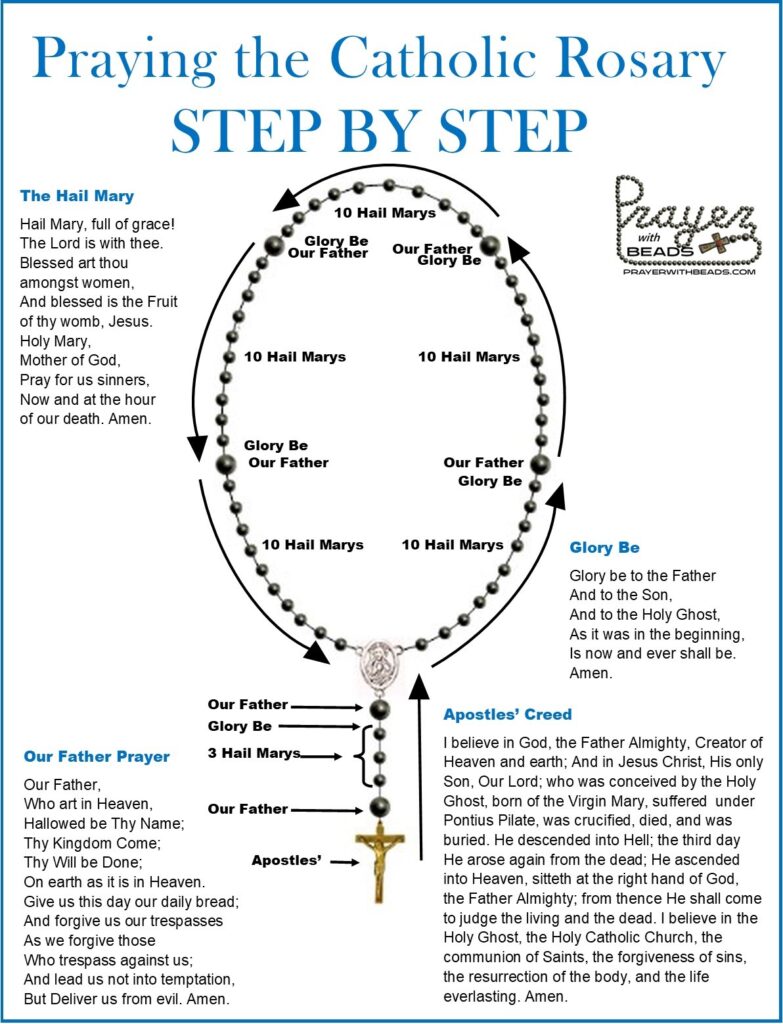
The rosary is carefully arranged so that each section of beads corresponds to a specific prayer.
Basic Components
Crucifix
Five decades (each decade consists of 10 small beads)
Separators between decades (usually larger beads, or sometimes equal-sized beads flanked by short sections of chain)
Centerpiece medal (often depicting Mary or a saint)
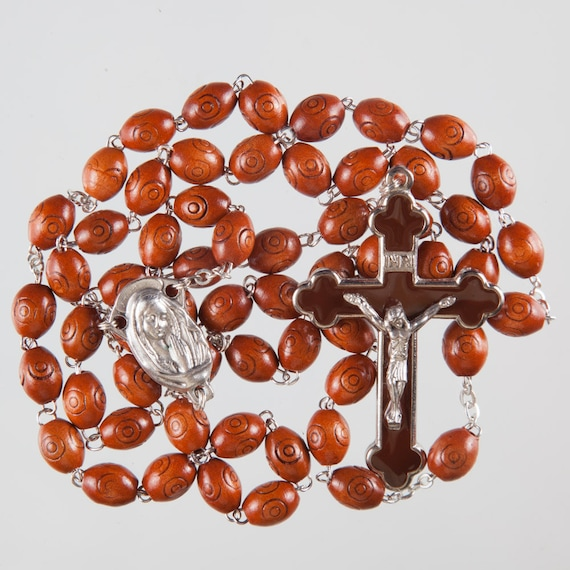
Rosary beads are typically connected to each other with metal links, as in the picture above, which improves the set’s durability. However, the beads may also be strung on a continuous cord.
How the Beads Are Organized
Each large bead marks an “Our Father”
Each group of ten small beads forms a “decade” of “Hail Mary” prayers
Each decade is paired with a meditation known as a Mystery
Rosary Bead Diagram (Standard Layout)
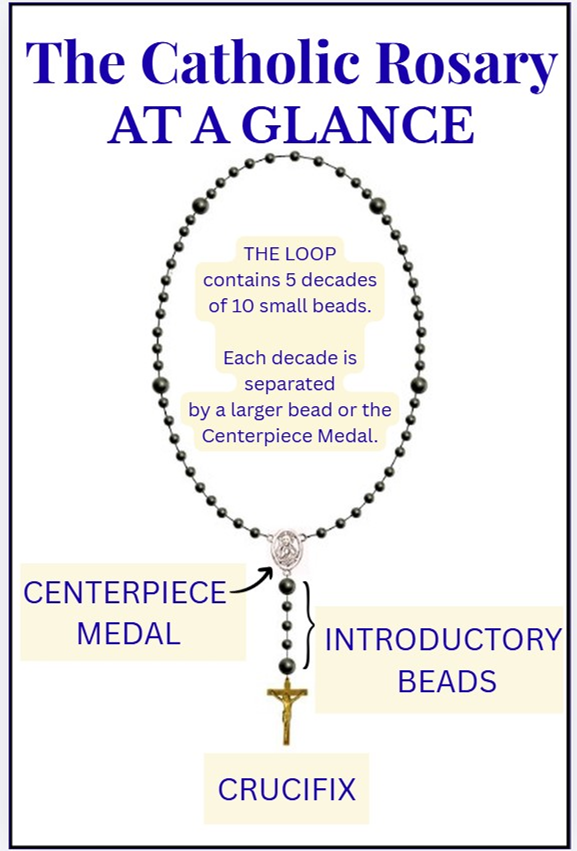
To help visualize the structure, the rosary can be understood as a combination of a short introductory strand and a circular loop of five decades.
The Four Sets of Mysteries
Each decade of the rosary is not only a sequence of prayers, but also an opportunity for meditation. These meditations are known as the Mysteries.
The Mysteries are grouped into four sets, each focusing on key events in the life of Christ:
- Joyful Mysteries
- Sorrowful Mysteries
- Glorious Mysteries
- Luminous Mysteries
Each set contains five individual Mysteries, which correspond to the five decades of the rosary.
The Joyful Mysteries
- The Annunciation
- The Visitation
- The Nativity
- The Presentation
- The Finding in the Temple
The Sorrowful Mysteries
- The Agony in the Garden
- The Scourging at the Pillar
- The Crowning with Thorns
- The Carrying of the Cross
- The Crucifixion
The Glorious Mysteries
- The Resurrection
- The Ascension
- The Descent of the Holy Spirit
- The Assumption
- The Coronation of Mary
The Luminous Mysteries
- The Baptism of Jesus
- The Wedding at Cana
- The Proclamation of the Kingdom
- The Transfiguration
- The Institution of the Eucharist
How the Mysteries Are Used in Prayer
When praying the rosary, one set of Mysteries is chosen. Each of the five decades is then paired with one Mystery from that set.
For example, if you are praying the Joyful Mysteries:
- The first decade reflects on the Annunciation
- The second decade reflects on the Visitation
- The third decade reflects on the Nativity
- The fourth decade reflects on the Presentation
- The fifth decade reflects on the Finding in the Temple
At the beginning of each decade:
- Announce the Mystery
- Pray the Our Father on the large bead
- Pray ten Hail Marys on the small beads while reflecting on the Mystery
- Conclude with the Glory Be
How to Reflect on a Mystery While Praying
While praying the Hail Marys of each decade, the Mystery is not meant to be analyzed in a detailed or intellectual way. Instead, it serves as a gentle point of focus.
Some people picture the scene in their mind, while others simply hold the theme of the Mystery in their awareness. The repeated prayers create a steady rhythm, allowing the mind to rest on the event without strain.
If your thoughts wander, you can simply return your attention to the Mystery. Over time, this combination of prayer and reflection becomes more natural and less effortful.
Choosing Which Mysteries to Pray
Traditionally, different sets of Mysteries are prayed on different days of the week:
- Monday and Saturday: Joyful Mysteries
- Tuesday and Friday: Sorrowful Mysteries
- Wednesday and Sunday: Glorious Mysteries
- Thursday: Luminous Mysteries
However, this pattern is a guide rather than a requirement. Some people choose a set of Mysteries based on personal focus or need for a particular time of prayer.
What Is a Chaplet?
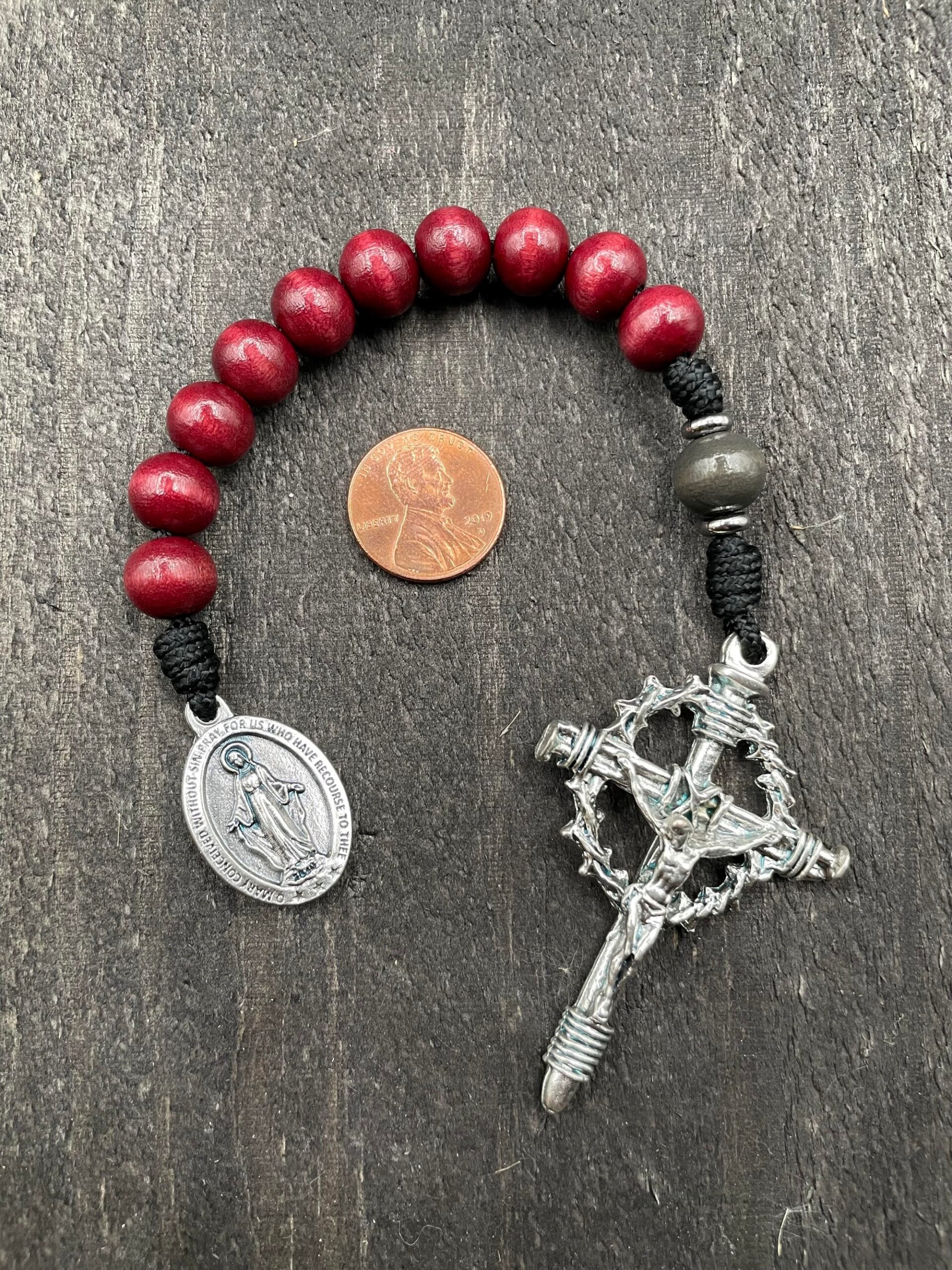
You may sometimes come across prayer beads that resemble a rosary but are shorter or arranged differently. These are often called chaplets.
A chaplet is a structured set of prayer beads used for a specific devotion. Like the rosary, Catholic chaplets guide prayer through a sequence of beads. However, each Catholic chaplet has its own unique structure and set of prayers, usually centered on a particular theme, event, or aspect of faith.
While the rosary follows a consistent five-decade pattern, Catholic chaplets vary widely in both their design and their purpose.
Understanding these differences can help you choose a form of prayer that aligns with your intentions. If you would like to compare this with other traditions, you may find it helpful to explore how other types of beads are structured and used.
Common Catholic Chaplet Structures
The Divine Mercy Chaplet
Often prayed on standard rosary beads
Uses the same five-decade structure
Different prayers replace the traditional rosary prayers
The Chaplet of Saint Michael
Typically consists of nine sections
Each section includes one large bead and three small beads
Represents the nine choirs of angels
The Seven Sorrows Chaplet
Contains seven groups of seven beads
Each group represents one of the sorrows of Mary
Often includes separator beads between groups
How Chaplets Differ from the Rosary
Chaplets are not simply shorter rosaries. They differ in several important ways:
They often have fewer beads
Their grouping patterns vary
Each chaplet follows a unique set of prayers
Their structure is tied to a specific devotion
If you encounter beads that look similar to a rosary but do not follow the five-decade structure described above, they are likely a chaplet or another type of prayer beads with a different structure and devotional use.
History of the Catholic Rosary
The rosary developed gradually over time as Christians sought ways to keep track of repeated prayers.
In the early Church, believers sometimes used pebbles or knotted cords to count prayers. By the Middle Ages, many people who could not read the Psalms began substituting them with repeated prayers such as the “Our Father.”
Over time, this practice became more structured. Tradition often associates the rosary with Saint Dominic, though historians generally understand it as something that developed over generations rather than being created all at once.
Why People Are Drawn to the Rosary
For many, the rosary becomes more than a practice. It becomes a companion in daily life.
It offers a structured path through prayer
It helps quiet anxious or distracted thoughts
It invites reflection on the life of Christ
It provides a sense of connection to generations of believers
Recommended Books and Resources
Books
The Secret of the Rosary by Saint Louis de Montfort
Rosary: Chain of Hope by Benedict Groeschel
Praying the Rosary Like Never Before by Edward Sri
Online Resources
United States Conference of Catholic Bishops
https://www.usccb.org/how-to-pray-the-rosary
Catholic Online
https://www.catholic.org/prayers/rosary.php
Dominican Rosary Center
https://rosarycenter.org
Where to Find Catholic Rosary Beads
If you are looking for a rosary, there are many thoughtful and well-crafted options available, ranging from simple and durable designs to more ornate devotional pieces.
Some well-known sources include:
- Rugged Rosaries
https://ruggedrosaries.com
Known for durable, heavy-duty rosaries designed for everyday use - The Catholic Company
https://www.catholiccompany.com
Offers a wide range of traditional and gift-quality rosaries - Autom
https://www.autom.com
A long-established supplier of church goods and devotional items
As with any devotional item, the most meaningful rosary is often one that you feel drawn to and will return to regularly in prayer.
Frequently Asked Questions About the Catholic Rosary
What is the difference between a rosary and a chaplet?
A rosary follows a consistent five-decade structure and is centered on meditating on the Mysteries of the life of Christ. A chaplet, by contrast, is a separate devotional practice with its own unique bead arrangement and set of prayers, often focused on a specific theme or aspect of faith.
How many beads are in a Catholic rosary?
A standard Catholic rosary consists of five decades, with each decade containing ten small beads. In addition to these fifty small beads, there are larger beads separating each decade, along with introductory beads and a crucifix.
Do you have to follow the Mysteries in order?
The Mysteries are traditionally prayed in a set order, with each decade corresponding to one Mystery within the chosen set. However, the order is meant to guide prayer rather than restrict it. Some people focus on a particular Mystery or adapt the structure to their personal prayer needs.
What if I get distracted while praying the rosary?
Distraction is a normal part of prayer. When your thoughts wander, you can gently return your attention to the Mystery or the rhythm of the prayers. Over time, this becomes easier, and the rosary can become a calming and steadying practice.
Can beginners pray the rosary?
Yes. While the structure may seem unfamiliar at first, many people find that it becomes natural with repetition. Using a guide, diagram, or step-by-step prayer resource can make it easier to begin.
Is there a “right way” to pray the rosary?
There is a traditional structure that many people follow, but the spirit of the rosary is one of prayerful reflection rather than strict performance. The goal is not perfection, but a sincere turning of the heart toward God.
A Gentle Invitation to Explore Prayer Beads
The Catholic rosary is one beautiful expression of prayer with beads, shaped by centuries of tradition and devotion.
As you explore different ways of praying with beads, you may also discover approaches that offer a different kind of flexibility. At PrayerWithBeads.com, the primary focus is on Protestant and Anglican prayer beads, along with books and guided prayer videos designed for use with them. At the same time, this site seeks to provide helpful information about many types of prayer beads so that you can explore, learn, and make informed decisions about what best supports your own prayer life.
One of the distinctive aspects of Protestant and Anglican prayer beads is their flexibility. They are not tied to a fixed set of prayers, which allows them to be used in many different ways.
If you are curious about how that works, you may find it helpful to learn more here:
Sources and Further Reading
The information in this article is drawn from a combination of historical tradition and widely recognized Catholic teaching on the rosary, along with the sources listed below.
For further reading and deeper exploration, the following sources may be helpful:
United States Conference of Catholic Bishops (USCCB)
https://www.usccb.org/how-to-pray-the-rosary
Dominican Rosary Center
https://rosarycenter.org
Catholic Online – Rosary Guide
https://www.catholic.org/prayers/rosary.php
For book recommendations, see the “Recommended Books and Resources” section above.
Explore Other Types of Prayer Beads
If you are interested in learning more about prayer beads from other traditions, you may also find these helpful:
👉 Tasbih (Islamic prayer beads)
