
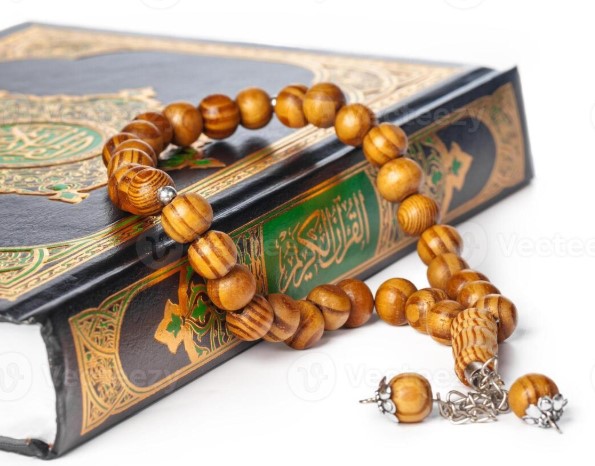
A tasbih (pronounced taz-BEEH) is a strand of Islamic prayer beads used to help count repetitions during dhikr (remembrance of God). Tasbih typically have 33, 34, or 99 beads and are used to repeat phrases such as “Subhan Allah,” “Alhamdulillah,” and “Allahu akbar” in a steady rhythm of prayer.
You may also hear these beads called a misbaha (pronounced miz-BAH-hah) or subha (pronounced SOOB-hah). These terms are often used interchangeably.
Tasbih are most commonly used during dhikr (pronounced ZIK-ar), which means “remembrance of God,” through the repetition of short phrases of praise.
If you are new to prayer beads in general, you may also find it helpful to read:
👉 What are Protestant prayer beads?
Understanding Islam and Muslim
Before going further, it helps to understand two basic terms:
- Islam (ISS-lahm) is a monotheistic religion centered on the worship of one God, called Allah (ah-LAH)
- Muslim (MOOZ-lim) is a follower of Islam
So:
- A Christian follows Christianity
- A Muslim follows Islam
While the beliefs and practices of Islam are distinct from Christianity, both traditions share a deep desire to honor God through prayer, reverence, and daily devotion.
Tasbih are one way many Muslims practice that remembrance.
The chart below explains key Islamic terms you’ll encounter when learning about tasbih, including dhikr (remembrance of God) and common phrases used in prayer.
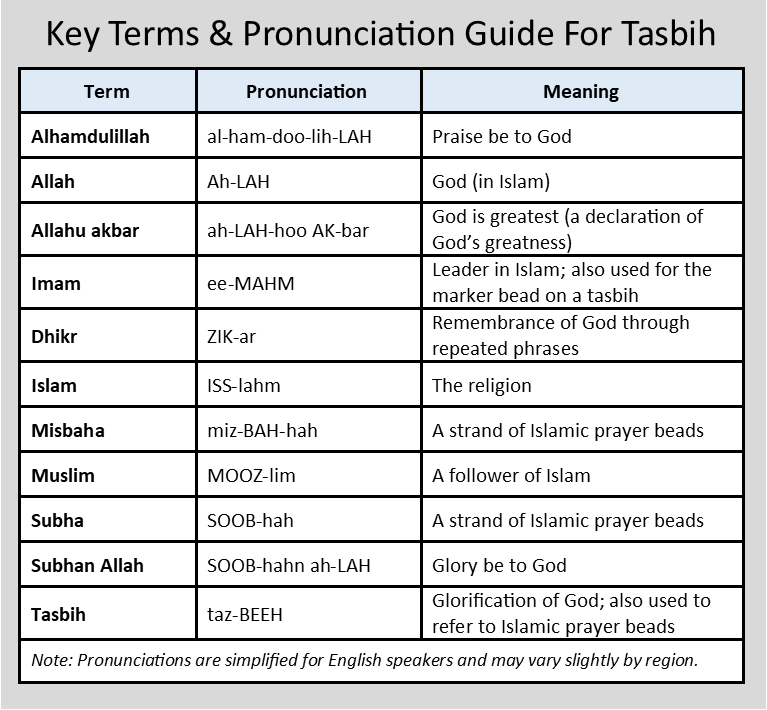
Common phrases used with a tasbih include:
- Subhan Allah (Glory be to God)
- Alhamdulillah (Praise be to God)
- Allahu akbar (God is greatest)
If you’re unfamiliar with these terms, refer to the pronunciation guide above.
Tasbih at a Glance
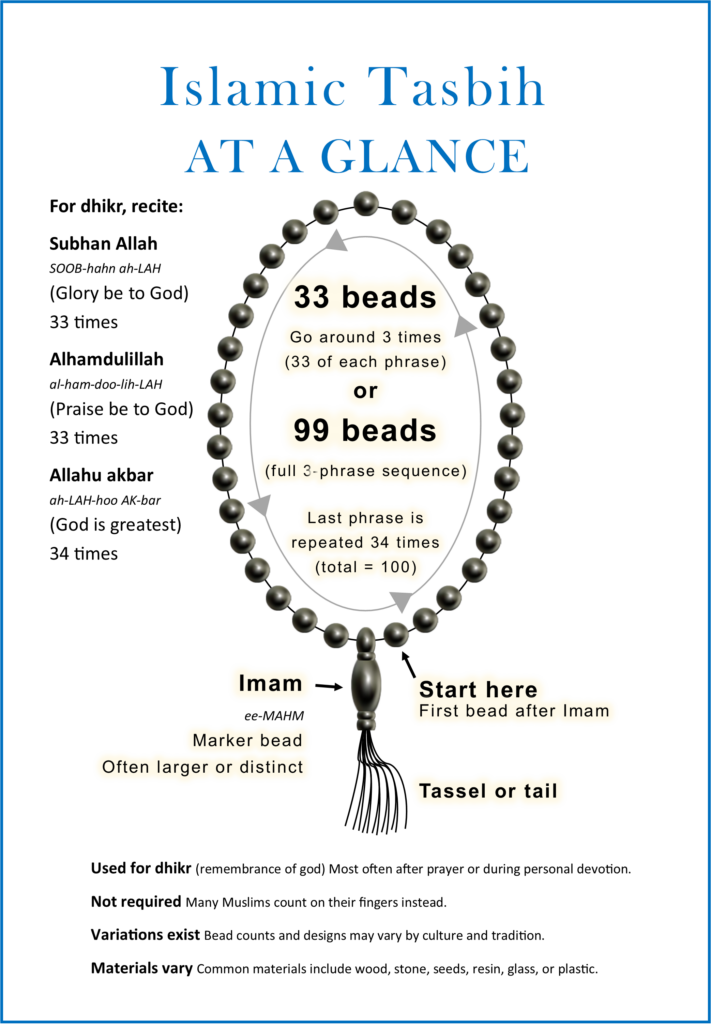
This diagram shows how a tasbih is used for dhikr (remembrance of God), using either a 33-bead cycle or a full 99-bead sequence.
How Tasbih Are Structured
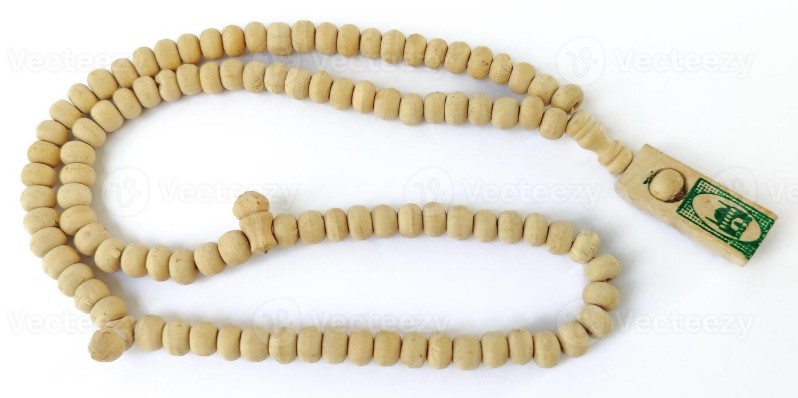
Typical structure:
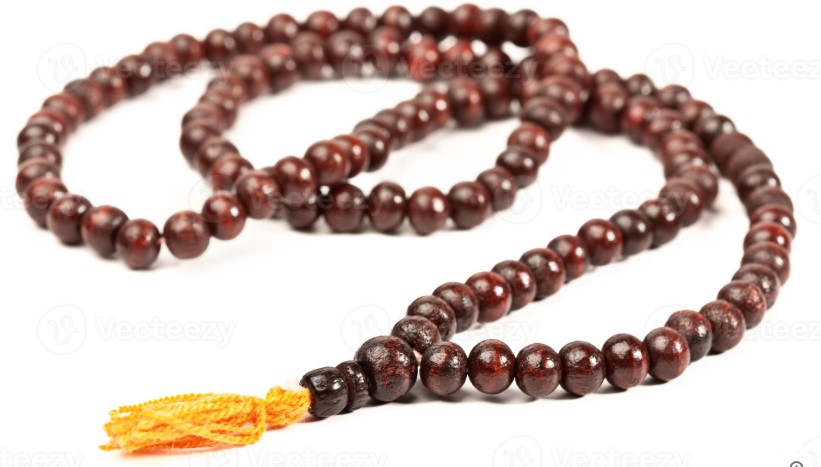
Tasbih are arranged as a loop of beads, with a distinct starting point marked by a larger bead or separator called the imām (pronounced ee-MAHM), and often ends in a tassel.
Prayer typically begins near this marker and proceeds bead by bead around the loop.
Shorter tasbih (33 or 34 beads) are often used in repeated cycles, while longer tasbih (99 beads) allow a full sequence of recitations to be completed in a single pass.
Some 99-bead tasbih, like the one in the picture above, include section markers that divide the beads into three groups of 33.
These markers serve as natural pauses and help the user keep track of each set of recitations, especially when repeating phrases such as Subhan Allah, Alhamdulillah, and Allahu akbar.
In some tasbih, the final section may include one additional bead, depending on the counting tradition being followed.
Tasbih are often made from natural materials such as wood, stone, or seeds, though modern versions may also be crafted from glass, plastic, or resin.
The material itself is not spiritually significant; what matters is the act of remembrance.
How Tasbih Are Used in Prayer (Dhikr)
Once you understand the structure, it becomes easier to see how tasbih are used in practice.
Common phrases include:
- Subhan Allah (SOOB-hahn ah-LAH) — Glory be to God
- Alhamdulillah (al-ham-doo-lih-LAH) — Praise be to God
- Allahu akbar (ah-LAH-hoo AK-bar) — God is greatest
Each phrase is typically repeated a set number of times, often 33 each.
The beads help maintain focus, rhythm, and attentiveness during prayer.
A simple way to use a tasbih:
1. Begin at the first bead after the Imam
2. Repeat Subhan Allah for 33 beads
3. Repeat Alhamdulillah for 33 beads
4. Repeat Allahu akbar for 33 beads (or 34, depending on tradition)
Why Some Tasbih Have 33 or 34 Beads
Many tasbih are made with 33 beads, which are used to repeat a set of phrases three times, for a total of 99 recitations.
However, some tasbih include 34 beads instead of 33.
This variation is based on differing traditional practices of counting dhikr. In some traditions, one of the phrases is repeated 34 times instead of 33, bringing the total to 100 recitations instead of 99.
Because of this, both 33-bead and 34-bead tasbih are commonly used, and either may be considered appropriate depending on the user’s preference or tradition.
Important Note (Respectful Clarity)
Tasbih are not required for Islamic prayer and are not used during the formal ritual prayers themselves.
They are most often used after prayer or during personal devotional time.
Some Muslims prefer counting on their fingers instead of using beads, while others use tasbih regularly. Both practices are accepted.
In addition to counting on the fingers, some people use small handheld or finger-worn counters as a modern way to keep track of dhikr recitations. These devices serve the same practical purpose as a tasbih—helping maintain count during repeated phrases—but without the use of beads. While convenient, many still prefer traditional tasbih for their tactile quality and the steady rhythm they provide during remembrance.
Simple Prayer Flow Example
A simple example using a 99-bead tasbih:
Begin near the marker bead (imām)
Repeat Subhan Allah for the first 33 beads
Repeat Alhamdulillah for the next 33 beads
Repeat Allahu akbar for the final 33 beads
This completes one full cycle of remembrance.
Some tasbih include divider beads that mark each section, allowing for a natural pause as you move through the sequence.
History of Tasbih
The use of tasbih developed over time as a practical way to support this kind of repeated remembrance.
Early Muslims often counted recitations on their fingers, and many Muslims still do so. Beads were introduced as early as the eighth century as a practical tool to help maintain consistency and focus during repeated remembrance.
Over time, beads came to be used across the Muslim world in a wide variety of forms.
The use of 99 beads is traditionally connected to the 99 Names of God, though shorter strands are also widely used.
Today, tasbih can be:
- Simple and functional
- Or beautifully crafted with stone, wood, or glass
How Tasbih Differ from Christian Prayer Beads
While both tasbih and Christian prayer beads are arranged in a loop shape to help guide prayer, they differ in structure and purpose.
Tasbih:
- Focus on repeated phrases of remembrance
- Centered on the oneness and greatness of God
- Used flexibly in personal devotion
Christian prayer beads (Catholic rosary, Protestant beads):
- Often follow structured prayers or themes
- May include meditation on scripture or events
The Catholic rosary follows a structured devotional pattern with specific prayers and meditations. (See: Catholic Rosary)
Protestant prayer beads, by contrast, are often used in a more flexible and customizable way. (See: Protestant Prayer Beads)
👉 The similarity of Islamic and Christian prayer beads is in the tool (beads)
👉 The difference is in the prayer tradition behind them
Unlike Protestant or Catholic prayer beads, tasbih structure is not symbolic; it is primarily functional for counting.
Who Uses Tasbih
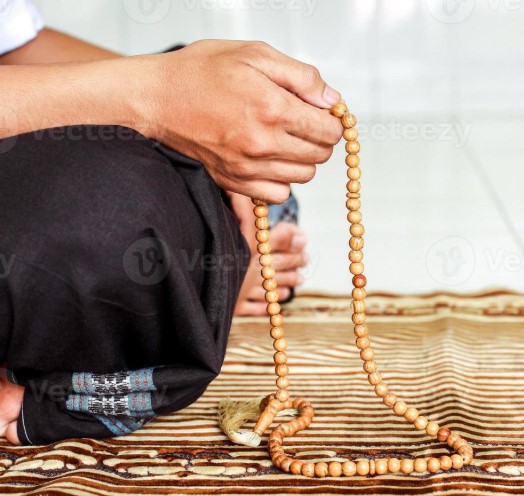
Tasbih are used by Muslims around the world as part of their devotional life.
If you are of a different faith or simply exploring various types of prayer beads, learning about tasbih can deepen your understanding of how Muslims seek to draw near to God through prayer.
If you are Muslim and looking to deepen your practice, we encourage you to seek guidance from trusted teachers and resources within your own tradition.
Where to Learn More (For Muslim Readers)
If you are a Muslim seeking deeper guidance:
- Local mosque or imam
- Trusted Islamic teaching websites
- Community-based instruction
This site provides a general overview but does not replace religious instruction within Islam.
Where to Find Tasbih
Tasbih are widely available through Islamic bookstores, cultural marketplaces, and online retailers.
They range from simple, functional strands to more decorative designs, depending on personal preference.
Frequently Asked Questions
What is a tasbih?
A tasbih is a strand of Islamic prayer beads used to count repetitions during dhikr, the remembrance of God.
How do you use a tasbih?
A tasbih is used by moving bead by bead while repeating short phrases such as Subhan Allah, Alhamdulillah, and Allahu akbar.
Do all tasbih have 99 beads?
No. Some tasbih have 33 beads, which are used by repeating one phrase on each bead, then repeating the process two more times with different phrases, for a total of 99 recitations.
Some tasbih have 34 beads, allowing one phrase to be repeated 34 times instead of 33, bringing the total to 100 recitations.
Tasbih with 99 beads allow all recitations to be completed in a single pass through the beads, with an additional repetition added if desired.
Are tasbih required in Islam?
No. They are a helpful tool for remembrance, but many Muslims also count prayers on their fingers.
Can non-Muslims use tasbih?
While anyone can physically use beads, tasbih are rooted in Islamic devotional practice and should be approached with understanding and respect.
A Gentle Closing Thought
Tasbih are simple in form, but meaningful in use.
They are not just beads. They are a tool for steady, repeated remembrance of God.
Across many traditions, people have used physical objects to help guide prayer and focus attention.
While the forms differ, the desire to slow down, reflect, and turn toward God is something many people share.
Explore Other Types of Prayer Beads
If you are interested in learning more about prayer beads from other traditions, you may also find these helpful:

