
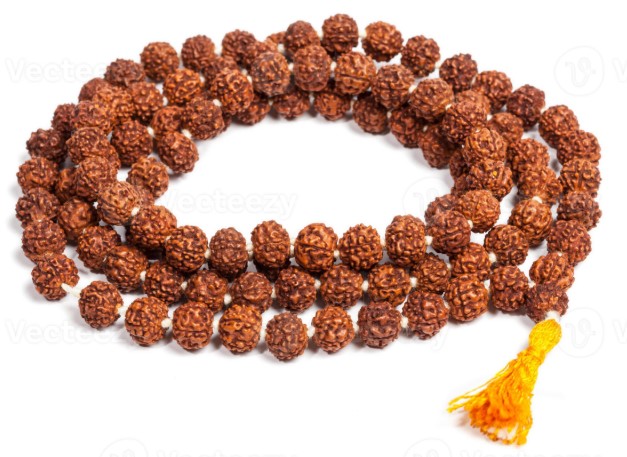
Mala prayer beads are a loop of beads used in Hindu, Buddhist, and, in some cases, Sikh traditions to guide repeated prayer or meditation. A person moves bead by bead, repeating a word or phrase each time, helping maintain focus and rhythm during spiritual practice.
They are most closely associated with religious traditions that began in the Indian subcontinent (South Asia), especially Hinduism and Buddhism. Today, Hinduism is practiced by more than a billion people, primarily in India and Nepal, while Buddhism has spread widely across East and Southeast Asia and has hundreds of millions of followers worldwide.
Key Terms and Pronunciation Guide
| Term | Pronunciation | Meaning |
|---|---|---|
| Atman | *AHT-muhn* | The soul or true self in Hindu belief |
| Bindi | *BIN-dee* | A decorative or symbolic dot worn on the forehead, often associated with Hindu culture; also called a tilak |
| Bodhi | *BOH-dee* | Awakening or enlightenment |
| Bodhisattva | *boh-dee-SAHT-vuh* | One who seeks enlightenment and helps others |
| Buddha | *BOO-duh* | “Awakened one”; a teacher, not a god |
| Guru | *GOO-roo* | A spiritual teacher; also the larger bead that marks the start/end of a mala loop |
| Japa | *JAH-puh* | Repetition of a sacred word, phrase, or name |
| Karma | *KAR-muh* | The idea that actions have consequences that shape future experiences |
| Krishna | *KRISH-nuh* | A form of God associated with devotion |
| Mala | *MAH-luh* | A loop of prayer beads |
| Mantra | *MAN-truh* | A sacred word or phrase |
| Meru bead | *MAY-roo* | Another name for the guru bead that marks the start/end on a mala |
| Murtis | *MOOR-tees* | Sacred images or statues used in Hindu worship |
| Nirvana | *nir-VAH-nuh* | Freedom from suffering and the cycle of rebirth |
| Shiva | *SHEE-vuh* | A Hindu deity associated with transformation |
| Tilak | *TEE-luk* | A mark placed on the forehead during Hindu religious practice; also called a bindi |
| Vishnu | *VISH-noo* | A Hindu deity associated with preservation |
| Yoga | *YO-guh* | Spiritual discipline, not just physical exercise |
Hinduism: History, Beliefs, and Practice
Hinduism is one of the oldest religious traditions in the world, with origins stretching back more than three thousand years in the Indian subcontinent. It did not begin with a single founder, but developed gradually through a combination of cultural traditions, sacred writings, philosophical ideas, and devotional practices.
Hindu teachings generally include the belief that there is a spiritual reality beyond the physical world and that each person possesses a soul, called the atman, that is connected to the divine. Many Hindus express devotion—meaning love, reverence, and worship—toward one or more forms of God, such as Vishnu, Shiva, or Krishna.
Worship may take place in temples or at home shrines, where murtis (sacred images or statues) are used to help focus attention and devotion. A mark on the forehead, such as a bindi or tilak, may also be worn as a sign of spiritual awareness or participation in religious life.
Most Hindu traditions teach that the soul continues after death and moves through repeated cycles of rebirth. These cycles are influenced by karma, the accumulated effects of a person’s actions. Over time, the goal is to be freed from this cycle and enter into a state of unity with the divine. This is believed to be achieved through a combination of devotion, right action, spiritual knowledge, and disciplined practices such as meditation and japa.
Buddhism: History, Beliefs, and Practice
Buddhism began around the 5th century BC in what is now northern India and Nepal. It is based on the teachings of Siddhartha Gautama, a historical figure who sought to understand the cause of human suffering and discovered a path toward inner peace through meditation and insight.
He became known as the Buddha, meaning “the awakened one,” and spent the rest of his life teaching others what he had learned. Buddhists view him not as a god, but as a teacher who showed the way to understanding and freedom.
Buddhist practice often takes place in temples, monasteries, or at home, sometimes with the presence of a Buddha statue. These statues are not worshipped as gods, but serve as reminders of the Buddha’s teachings and example.
Buddhism teaches that life continues through cycles of death and rebirth and that the nature of one’s lifetimes is shaped by karma. Over time, karma is understood to accumulate, influencing future experiences and conditions.
The goal of Buddhist practice is to reach nirvana, a state of complete freedom from suffering and the cycle of rebirth. This is believed to be achieved through ethical living, mental discipline, meditation, and the development of wisdom and understanding.
Sikhism: History, Beliefs, and Practice
Sikhism began in the 15th century in the Punjab region of South Asia and is based on the teachings of Guru Nanak and the Sikh Gurus who followed him. It emphasizes devotion to one God, honest living, service to others, and continual remembrance of the divine.
A central practice in Sikh spirituality is Naam Simran, the repetition or meditation on the name of God. This remembrance is not limited to a specific time or place, but is encouraged as an ongoing awareness throughout daily life.
Unlike Hindu and Buddhist traditions, which more commonly incorporate malas into structured practice, Sikh teaching generally places less emphasis on physical tools. The focus is instead on internal, continuous remembrance.
However, some Sikhs do use mala beads as an aid to concentration during prayer or meditation, particularly when beginning or establishing a rhythm of repetition. In these cases, the mala functions in a similar way—supporting focus and helping maintain attention—while the deeper goal remains inward remembrance rather than reliance on the beads themselves.
How Malas Are Used
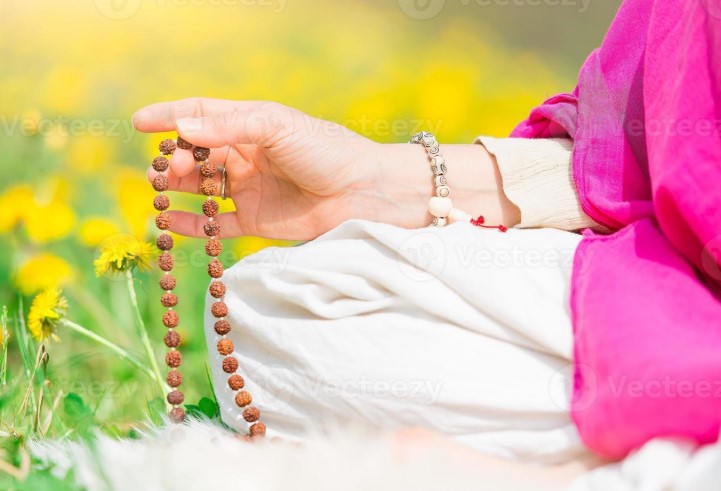
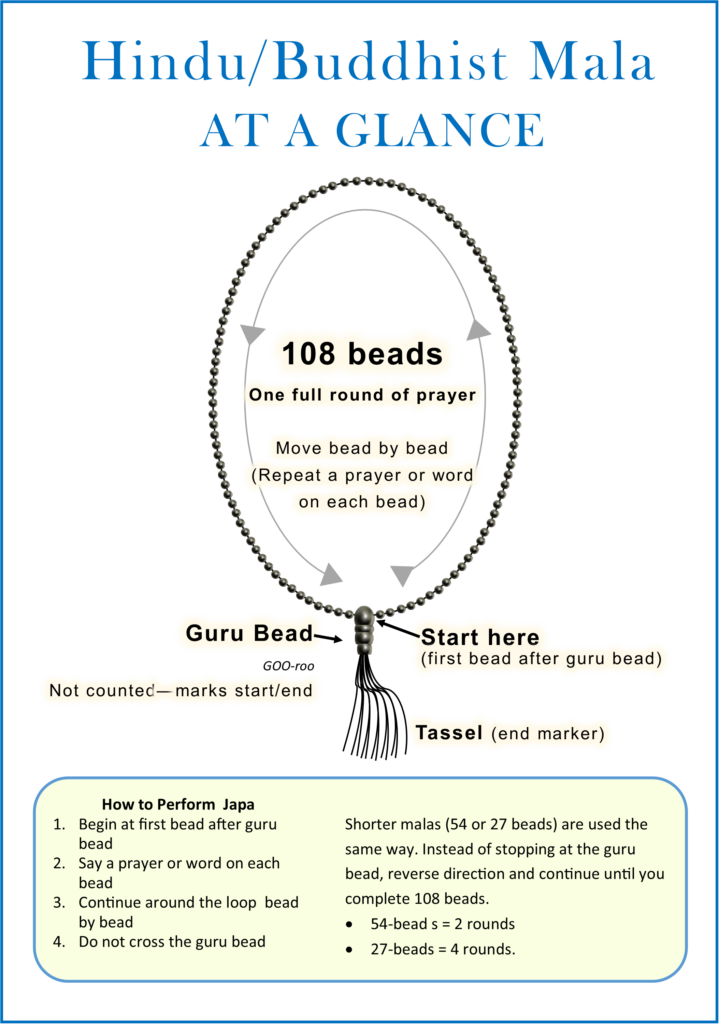
Mala beads are used to support repeated prayer or meditation, often called japa. A person begins near the larger bead (guru or meru bead) and moves bead by bead, repeating a word, prayer, or phrase with each one.
When the larger bead is reached again, it is not counted. Instead, the person typically pauses or reverses direction. This helps maintain a steady flow of attention without breaking the rhythm of the practice.
A traditional mala contains 108 beads, and completing one full loop represents a complete round of practice. Shorter malas, such as those with 54 or 27 beads, are used in the same way, often with multiple rounds completed.
When multiple rounds are done on a shorter mala, prayer flow is reversed for each round, rather than crossing over the guru bead.
Japa may be spoken aloud, whispered, or repeated silently. In Hindu practice, it is often directed toward God. In Buddhist practice, it is often used to focus the mind and develop awareness and compassion. In Sikh practice, similar repetition may be used as part of Naam Simran (remembrance of God), though the emphasis remains on continual, inward remembrance rather than the physical act of counting beads.
Types of Mala Beads
| Bead Type | Material | Hindu Use | Buddhist Use | Why Chosen |
|---|---|---|---|---|
| Tulsi | Basil wood | Yes | Rare | Associated with devotion |
| Rudraksha | Tree seeds | Yes | Rare | Linked with Shiva |
| Sandalwood | Wood | Yes | Yes | Calming and fragrant |
| Bodhi seed | Seed | No | Yes | Associated with enlightenment |
| Bone | Animal bone | No | Yes (some traditions) | Reminder of impermanence |
| Stone | Natural stone | Yes | Yes | Symbolic or aesthetic |
| Glass / Resin / Plastic | Manufactured materials | Occasional | Occasional | Common in modern malas; typically used for affordability or decorative purposes rather than traditional religious practice |
Traditional and Modern Malas
In traditional religious settings, malas are treated as spiritual tools rather than accessories. They are used in structured prayer or meditation practices and may be connected to a particular tradition, teacher, or lineage. Because of their sacred purpose, some practitioners choose not to wear them casually, especially if the mala has been used in prayer. In Sikh practice, where malas are used, they are generally seen as a support for focus rather than a required or central element of spiritual life.
At the same time, malas are also used outside of formal religious contexts. Many people today use them for personal meditation, reflection, or as a reminder to stay focused or calm. In these cases, malas are often worn as necklaces or bracelets.
While the physical form may look the same, the meaning and intention behind their use can be quite different. Understanding this distinction helps a person decide how they wish to use a mala in a way that feels both meaningful and respectful.
Choosing a Mala
Choosing a mala is often a personal decision. Some people are drawn to a particular material, such as wood, seeds, or stones, while others focus more on how the mala will be used.
For those engaging in a specific religious practice, the choice may be guided by tradition, a teacher, or the intended purpose of the mala. Others may simply be looking for a tool to support quiet reflection or repeated prayer.
Even when used in a personal or non-religious way, understanding where a mala comes from and how it has been used historically can add depth and meaning to the experience.
If you are buying a mala for religious practice, look for clear information about its materials, bead count, and tradition. If you are buying it for personal use, taking time to understand its background is still a respectful and helpful step.
Where to Buy Mala Beads
If you are interested in purchasing mala beads, there are several types of sources to consider, depending on your intended use.
Hindu Sources
Giri USA offers traditional Hindu devotional items, including tulsi and rudraksha malas that are commonly used in religious practice.
https://giriusa.com/collections/japa-mala-beads
Buddhist and Traditional Sources
Tibetan Nuns Project offers malas made and blessed by Tibetan Buddhist nuns. Purchases also support the education and well-being of the nuns.
https://tnp.org
DharmaShop is a retail store that specializes in Tibetan Buddhist malas and ritual items, offering a variety of traditional styles.
https://www.dharmashop.com
Sikh Sources
Because the use of mala beads is less central in Sikh practice, fewer retailers specialize specifically in Sikh malas. However, some Sikh and Punjabi religious goods stores do offer simple mala strands that may be used for personal prayer or meditation.
Sikh Store provides a variety of Sikh religious items and may occasionally carry mala-style beads suitable for personal use.
https://www.sikhstore.com
Punjab Heritage and other Punjabi cultural retailers may also offer prayer beads or similar items as part of traditional goods.
When purchasing from these sources, it is helpful to keep in mind that in Sikh practice, the emphasis is not on the beads themselves, but on the continual remembrance of God (Naam Simran). For many, the beads serve simply as a tool to support focus rather than a central part of the practice.
Independent Retailers
Sakura Designs (buddhistmala.com) offers handcrafted malas, including designs inspired by traditional materials and patterns.
https://buddhistmala.com
Online Resources
YoWangdu provides clear, beginner-friendly explanations of Tibetan Buddhist practices, including how malas are used in meditation.
https://www.yowangdu.com/tibetan-buddhism/malas.html
SikhNet offers accessible explanations of Sikh beliefs and practices, including Naam Simran and devotional life.
https://www.sikhnet.com
Encyclopaedia Britannica is a well-known general reference source that offers reliable background information on Hinduism, Buddhism, Sikhism, and related topics.
https://www.britannica.com
Oxford Reference is an academic resource that provides definitions and explanations of religious and scholarly terms.
https://www.oxfordreference.com
Frequently Asked Questions
Can malas be worn as necklaces or bracelets?
Yes, especially in modern use. Many people wear malas as a reminder of intention or focus. In traditional religious settings, however, some practitioners prefer not to wear them casually out of respect for their sacred use.
Do all Hindus and Buddhists use malas?
No. While malas are widely used, they are not required. Many people in both traditions practice without using prayer beads.
Do all practitioners perform japa?
No. Japa is one of many spiritual practices and is not used by everyone.
How often is japa performed?
In Hindu practice, japa is often performed daily as part of personal devotion. In Buddhism, it may be used during meditation sessions or specific practices. The frequency varies by tradition and individual.
Are there preferred places for using a mala?
Malas may be used at home, in temples, in group settings, or in quiet personal spaces. While some traditions prefer a calm environment, the practice itself is flexible.
How are malas stored between uses?
Malas are often kept in a pouch, cloth bag, or on a clean surface. In traditional settings, they are treated with respect and care.
Is japa performed privately or in groups?
Both. In Hindu practice, it is often done privately, while in Buddhist settings it may be practiced both individually and in group contexts.
Do Sikhs use mala beads?
Some do, but their use is less central than in Hindu or Buddhist traditions. Sikh teaching emphasizes continuous remembrance of God (Naam Simran), which is not dependent on physical tools, though beads may be used as an aid to focus.
Explore Other Types of Prayer Beads
If you are interested in learning more about prayer beads from other traditions, you may also find these helpful:

