A Quiet Tool for the Jesus Prayer
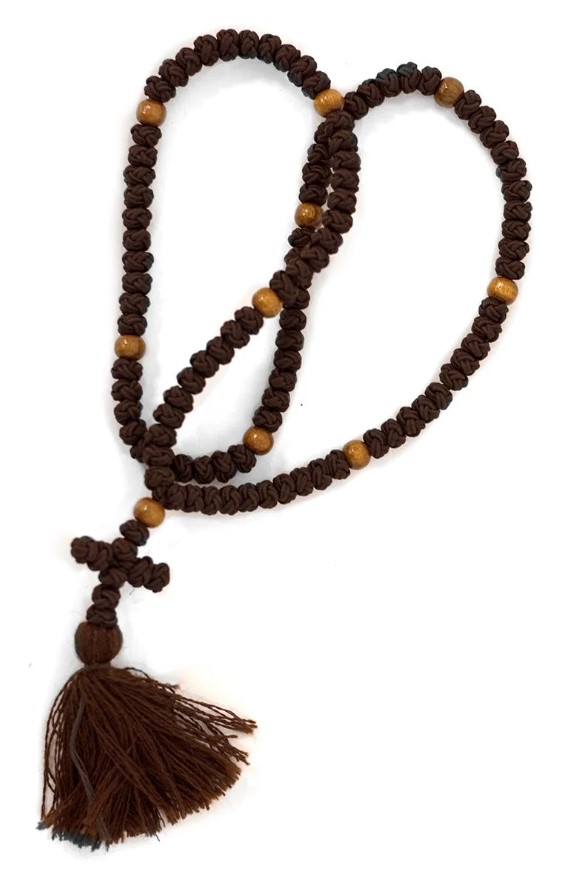
An Orthodox prayer rope, known as chotki (Russian) or komboskini (Greek), is a loop of knotted cord used in Eastern Christian prayer, most often for repeating the Jesus Prayer:
“Lord Jesus Christ, Son of God, have mercy on me.”
It is most closely associated with Eastern Orthodox Christianity, though it is also used in some Eastern Catholic and Oriental Orthodox traditions.
Unlike many forms of prayer beads made from individual beads, the traditional Orthodox prayer rope is formed from a continuous loop of hand-tied knots. Each knot marks a single prayer, creating a steady rhythm that helps the person remain attentive, present, and focused.
The Orthodox prayer rope is not primarily decorative. In Orthodox practice, it is a quiet, practical tool—held in the hand, moved one knot at a time, and used to support a life of prayer rooted in humility and repetition.
Understanding Eastern Orthodox Christianity
To understand the Orthodox prayer rope, it helps to understand the tradition it comes from.
Eastern Orthodox Christianity is one of the oldest branches of the Christian Church, tracing its roots to the early centuries of Christianity. It is especially connected with regions such as Greece, Russia, Ukraine, Romania, Serbia, and other parts of Eastern Europe and the eastern Mediterranean.
Orthodox Christian life centers on worship of the Trinity—Father, Son, and Holy Spirit—and on a lifelong process of spiritual transformation through prayer, repentance, and participation in the life of the Church.
Within this context, the Orthodox prayer rope is not a standalone practice. It is one small part of a much larger rhythm of prayer.
The History of the Orthodox Prayer Rope
The origins of the Orthodox prayer rope are closely tied to early Christian monastic life.
Tradition often connects its development to St. Pachomius the Great (c. 292–346 AD), one of the early organizers of communal monasticism in Egypt.
According to tradition, monks used simple methods—such as pebbles or cords—to count repeated prayers. Over time, these developed into knotted ropes that were easier to carry and use throughout the day.
The Orthodox prayer rope became closely associated with the repetition of the Jesus Prayer and remains an important part of both monastic and lay prayer life today.
The Jesus Prayer
At the heart of the Orthodox prayer rope is the Jesus Prayer:
“Lord Jesus Christ, Son of God, have mercy on me.”
A longer form often adds:
“…a sinner.”
This short prayer expresses central elements of Christian faith: recognition of Christ, humility, repentance, and a continual turning toward God.
The Orthodox prayer rope provides a simple structure—one knot, one prayer—helping the person remain attentive rather than distracted.
How an Orthodox Prayer Rope Is Used
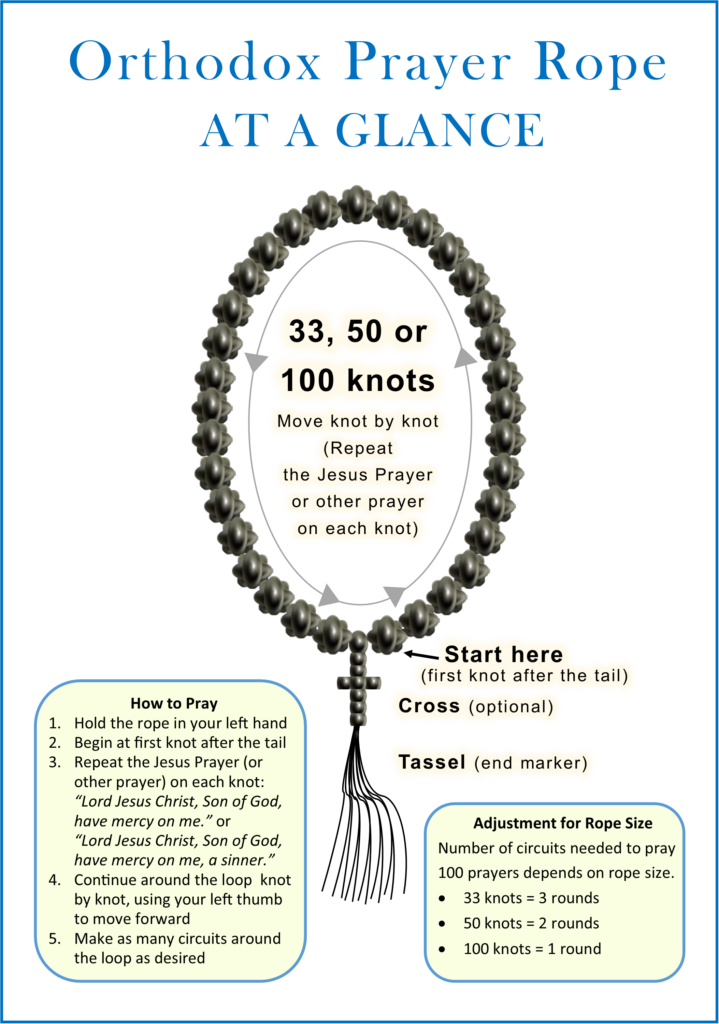
An Orthodox prayer rope is held in the hand and moved one knot at a time, with one repetition of the Jesus Prayer on each knot.
It may be used quietly at home, while walking, or during moments of stillness throughout the day. Some people pray aloud, others whisper, and many pray silently.
Traditionally, the rope is often held in the left hand, leaving the right hand free to make the sign of the cross. It may also be worn around the left wrist or carried in the left pocket, not as decoration but as a quiet reminder to return to prayer.
A user holds each knot between the left thumb and forefinger and uses the thumb to move from knot to knot.
Some Orthodox Christians coordinate the prayer with breathing, but deeper methods of practice are usually approached under spiritual guidance.
Structure of an Orthodox Prayer Rope
An Orthodox prayer rope is almost always formed as a continuous loop, representing an unbroken rhythm of prayer.
Knots and Loop Form
The rope consists of a series of hand-tied knots, most commonly 33, 50, or 100.
The number of knots on an Orthodox prayer rope is not random and often carries symbolic meaning.
33 knots are the most common for personal use, representing the 33 years of Christ’s earthly life. These are sometimes divided into three groups of 11 knots, reflecting the Holy Trinity.
50 knots are also common and are sometimes associated with Pentecost and the descent of the Holy Spirit.
100 knots are traditionally used in monastic settings for longer and more disciplined prayer.
Larger ropes of 150, 200, 300, or even 500 knots may also be used, especially by monks and hermits.
Less common variations exist as well. For example, a 41-knot rope in Ethiopian Orthodox tradition reflects the sufferings of Christ, while a 64-knot rope has been associated with the age of the Virgin Mary at her Assumption.
The “Tail” of the Loop
Although the rope forms a loop, most Orthodox prayer ropes include a distinct section extending from it. This may include a cross, tassel, bead, or a combination of these elements. The cross identifies the rope as a Christian prayer tool, while the tassel and other elements add both meaning and function.
Marker Beads
Some Orthodox prayer ropes include marker beads placed at intervals, such as every 10, 25, or 50 knots. These are typically made from wood, glass, stone, or metal.
Their purpose is practical—helping a person keep their place during longer prayer sessions—while also providing a tactile variation that helps maintain focus.
Materials
Traditional Orthodox prayer ropes are most often made from wool, though cotton, silk, and synthetic cords are also used.
Wool is especially meaningful, often associated with Christ as the Good Shepherd caring for His flock.
Color: Are They Always Black?
Most traditional Orthodox prayer ropes are black, symbolizing repentance, humility, and a sober approach to prayer.
However, other colors are also used, including red (often associated with the blood of Christ or martyrdom), white (sometimes used for joyful or baptismal contexts), and natural or earth tones. While black remains the most traditional, color choices may vary.
Bracelet Forms
Many Orthodox prayer ropes are made in smaller sizes designed to be worn around the wrist. These often contain 10, 20, or 33 knots and are typically worn on the left wrist as a quiet reminder to pray throughout the day.
Even in bracelet form, they are traditionally treated as prayer tools rather than jewelry.
Why Knots Instead of Beads?
The use of knots is one of the most distinctive features of the Orthodox prayer rope.
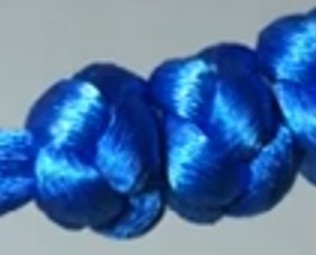
Traditional knots are tied in intricate patterns that form small crosses within each knot, giving the rope a deeply symbolic structure.
The Seven Crosses Within Each Knot
In many traditional Orthodox prayer ropes, each knot is tied in a way that forms seven small crosses. These crosses are understood to carry several layers of spiritual meaning.
According to Orthodox tradition, early monks found that simple knots could be undone, disrupting their prayers. A commonly shared account connects the development of the complex knot to a spiritual insight that the knot should be formed through repeated signs of the cross. Because of this, it came to be understood that such knots could not be undone by the devil.
The number seven also carries symbolic meaning in Christian tradition. It is often associated with spiritual completeness, echoing the seven days of Creation. Some interpretations see the seven crosses as a reminder of protection against sin, while others associate them with the soul’s ascent toward God.
In some traditions, knots may be tied with nine crosses instead, symbolizing the nine ranks of angels. However, the seven-cross knot remains the most widely recognized form.
This understanding emphasizes that each knot is not only a counting tool, but also a reminder of Christ’s victory through the cross.
For those interested in learning how these knots are made:
How to Tie an Orthodox Prayer Rope
The Meaning of the Tassel
The tassel found on many Orthodox prayer ropes carries both symbolic and practical meaning.
It is often associated with tears of repentance and a softened, prayerful heart. Some traditional explanations suggest that the tassel may be used—literally or symbolically—to wipe away tears during prayer.
The tassel also serves a practical purpose, helping to mark both the beginning and the ending of the rope.
Some prayer ropes include red tassels or threads, which are sometimes understood as representing the blood of Christ or sacrificial love.
Prayer Ropes in Monastic and Everyday Life
Orthodox prayer ropes are deeply rooted in monastic life, where they are used as part of a structured rhythm of prayer throughout the day.
At the same time, they are widely used by laypeople in quiet and personal ways. A person may keep an Orthodox prayer rope in a pocket, wear it around the left wrist, or hold it during moments of stillness, allowing prayer to become part of everyday life.
The emphasis is not on outward display, but on inward attention. The Orthodox prayer rope serves as a quiet companion in prayer, helping the person return again and again to Christ.
Icons and Prayer Spaces
In many Orthodox homes, prayer takes place in a small designated space often called an icon corner.
These spaces typically include painted icons—flat, stylized sacred images—of Christ, Mary, and the saints, along with a cross and sometimes candles or lamps.
Statues are generally not used in Eastern Orthodox practice. Icons are the traditional visual form and are honored (not worshipped) as images that direct the heart toward God.
An Orthodox prayer rope may be used in this setting, though it can also be used anywhere with reverence.
Where to Buy Orthodox Prayer Ropes
Orthodox prayer ropes are often handmade and are traditionally purchased from monasteries, convents, or trusted Orthodox retailers. These sources not only provide authentic items, but often support the work of Orthodox communities.
Holy Nativity Convent offers traditional wool prayer ropes and supports Orthodox communities through its work.
St. Paisius Monastery Gift Shop provides handmade prayer ropes in traditional styles.
Monastiriaka (Mount Athos Store) offers Greek Orthodox komboskini connected with Athonite traditions.
Legacy Icons is a well-known Orthodox retailer offering a range of prayer ropes and devotional items.
Books and Further Reading
The Way of a Pilgrim — A classic Russian Orthodox spiritual text centered on the Jesus Prayer and the desire to “pray without ceasing.”
The Art of Prayer — A collection of Orthodox teachings on prayer, offering deeper insight into spiritual practice.
On the Prayer of Jesus — A traditional Orthodox work focusing on the discipline and meaning of the Jesus Prayer.
The Jesus Prayer — A short and accessible introduction to this central prayer of Orthodox spirituality.
Online Resources
Orthodox Church in America — Official North American Orthodox resource for teachings and practices.
Greek Orthodox Archdiocese of America — Provides guidance on prayer and Orthodox Christian life.
St. George Greek Orthodox Cathedral — Includes helpful explanations of prayer rope use.
Frequently Asked Questions
What is an Orthodox prayer rope?
An Orthodox prayer rope is a loop of knots used to count repeated prayers, especially the Jesus Prayer.
Is an Orthodox prayer rope the same as a Catholic rosary?
No. The Catholic rosary follows a structured sequence of prayers, while the Orthodox prayer rope is typically used for repeated prayer.
How many knots does an Orthodox prayer rope have?
Common sizes include 33, 50, or 100 knots.
Why is an Orthodox prayer rope usually black?
Black symbolizes repentance and humility, though other colors such as red, white, and natural tones are also used.
Can non-Orthodox Christians use Orthodox prayer ropes?
Yes, though it is best to use them with respect for their origins and meaning.
Can I make my own Orthodox prayer rope?
Yes. Some people choose to make their own as a form of prayerful work. Traditional knot-tying methods can be complex. A helpful guide is available here:
How to Tie an Orthodox Prayer Rope
Are Orthodox prayer ropes ever made using beads instead of knots?
Traditionally, no. Knots are central to the Orthodox prayer rope, though some modern variations may include beads.
Explore Other Types of Prayer Beads
If you are interested in learning more about prayer beads from other traditions, you may also find these helpful:

